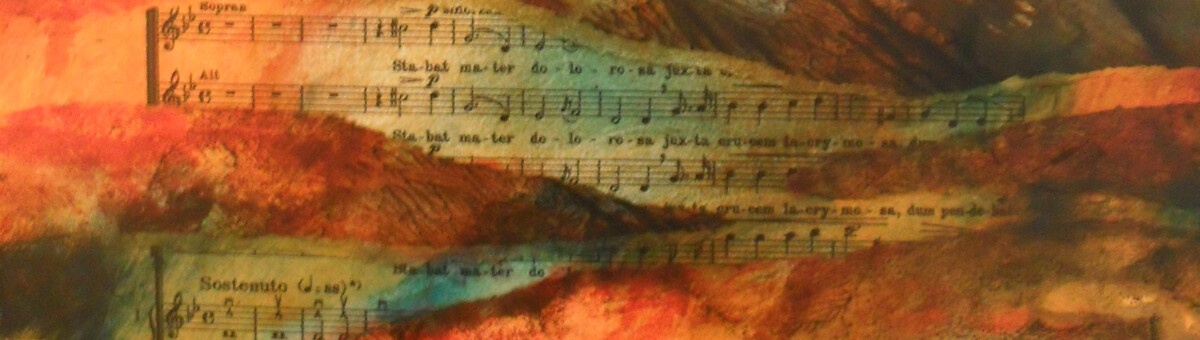
When I first came across Ina van Dijk’s Stabat Mater series, I was struck by how her approach, abstract, intuitive, rooted in the sound of Palestrina , mirrors what this website has always been about: the many ways in which this medieval text continues to move people across centuries and disciplines. Ina was kind enough to write about her work and her path towards it. I am glad to share her words here.
Painting as a Path
Drawing and painting came naturally to me from an early age. In 1986 I completed my training in art therapy at the Wervel institute, after which I worked as an art therapist and taught painting courses — in my own studio as well as elsewhere.
Materials and Process
Over the years my own work shifted from watercolour to acrylics, which I love for their directness, quick drying time and intensity of colour. I also enjoy working with pastels, which offer a surprising range — including deep, dark tones that people don’t always associate with the medium.
My starting point is rarely the visible world. Instead, I feel my way towards a result: a word, a phrase, a feeling becomes the guide. Colours and forms emerge through searching. Sometimes, years later, I return to a canvas and paint over it entirely.
I also leave my work untitled — deliberately. A title steers the eye. Without one, the viewer is free to look and discover for themselves.
Series
I find it particularly rewarding to work in series. Over the years I have painted the Stations of the Cross, Schoenberg’s Gurre-Lieder, the Book of Revelation — and the Stabat Mater.
The Stabat Mater
When I first heard Palestrina’s setting of the Stabat Mater, it made a deep impression on me. Text and music are in perfect harmony. Around 2010 I decided to paint a series based on this work — ten canvases of 30 x 30 cm, one for each verse.
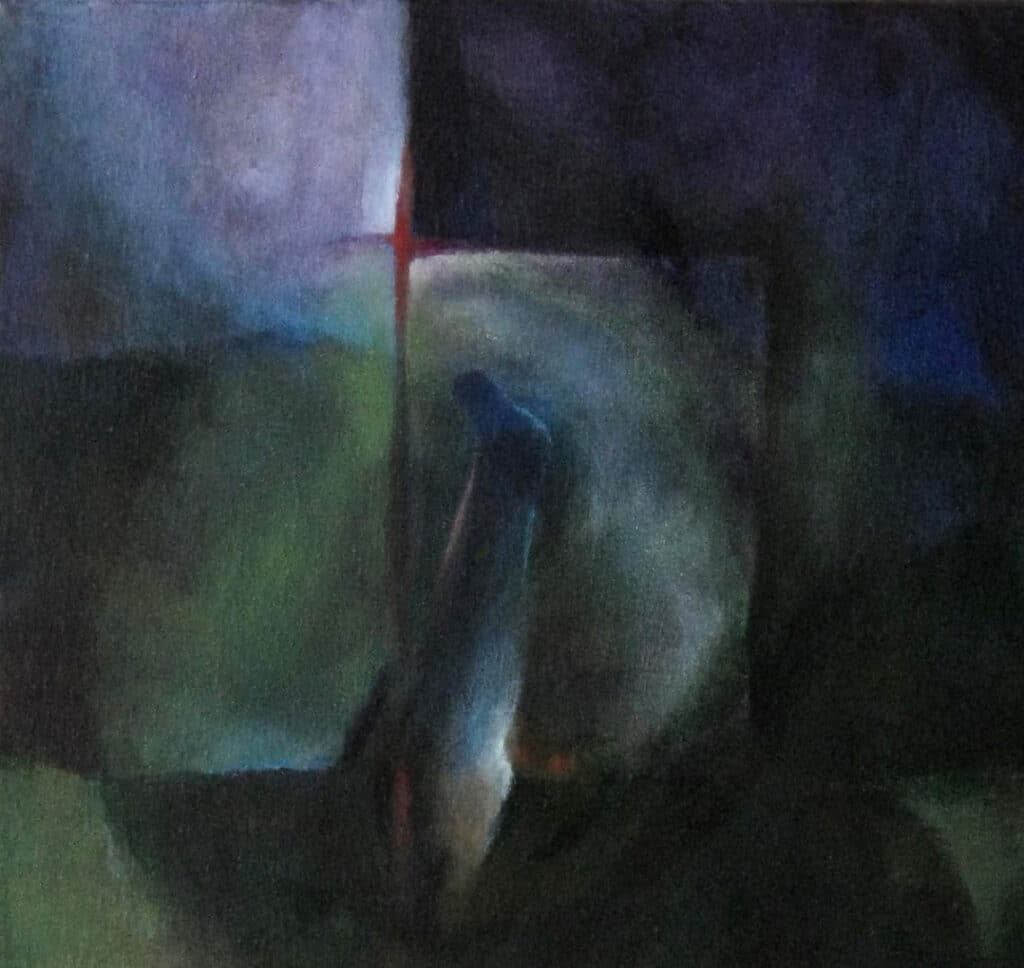
I studied various translations, and my knowledge of Italian helped me develop a feeling for the text. From there I searched for the simplest forms and colour moods that, for me, matched each verse and its music.
The Stabat Mater conveys an intense, deeply human grief — a mother’s sorrow — and offers the listener something to hold on to. That moved me, and I hope it is visible in the paintings.
Watch the complete series at https://www.youtube.com/watch?v=ywRcnjsCPTs